Screen time increased 2.2% year-over-year in 2024-2025, climbing back to pandemic-era peaks of 6 hours 54 minutes daily (DataReportal, 2025). But this time, there are no lockdowns forcing people indoors. The increase is voluntary, habitual, and accelerating. The average person now spends 6 hours 45 minutes on screens daily, roughly 42% of waking life assuming 8 hours of sleep (DataReportal, 2025). At this rate, the average person will spend 19.1 years of their life staring at digital displays. For Gen Z, that number climbs to 28.8 years.
The average person uses 6.7 social media platforms (DataReportal, 2025). At documented average daily rates across those platforms, that translates to roughly 3 hours 15 minutes of social media alone, not counting streaming, gaming, or work. Add TikTok (95 minutes), YouTube (49 minutes), Instagram (38 minutes), Facebook (31 minutes), and Snapchat (30 minutes), and you've burned over 4 hours before checking Reddit, Pinterest, or LinkedIn. If you used every major social platform at its average rate, you'd spend 5 hours and 19 minutes scrolling per day. The stack compounds. Each app you add isn't a 5-minute distraction. It's a recurring 20-50 minute commitment, every single day.
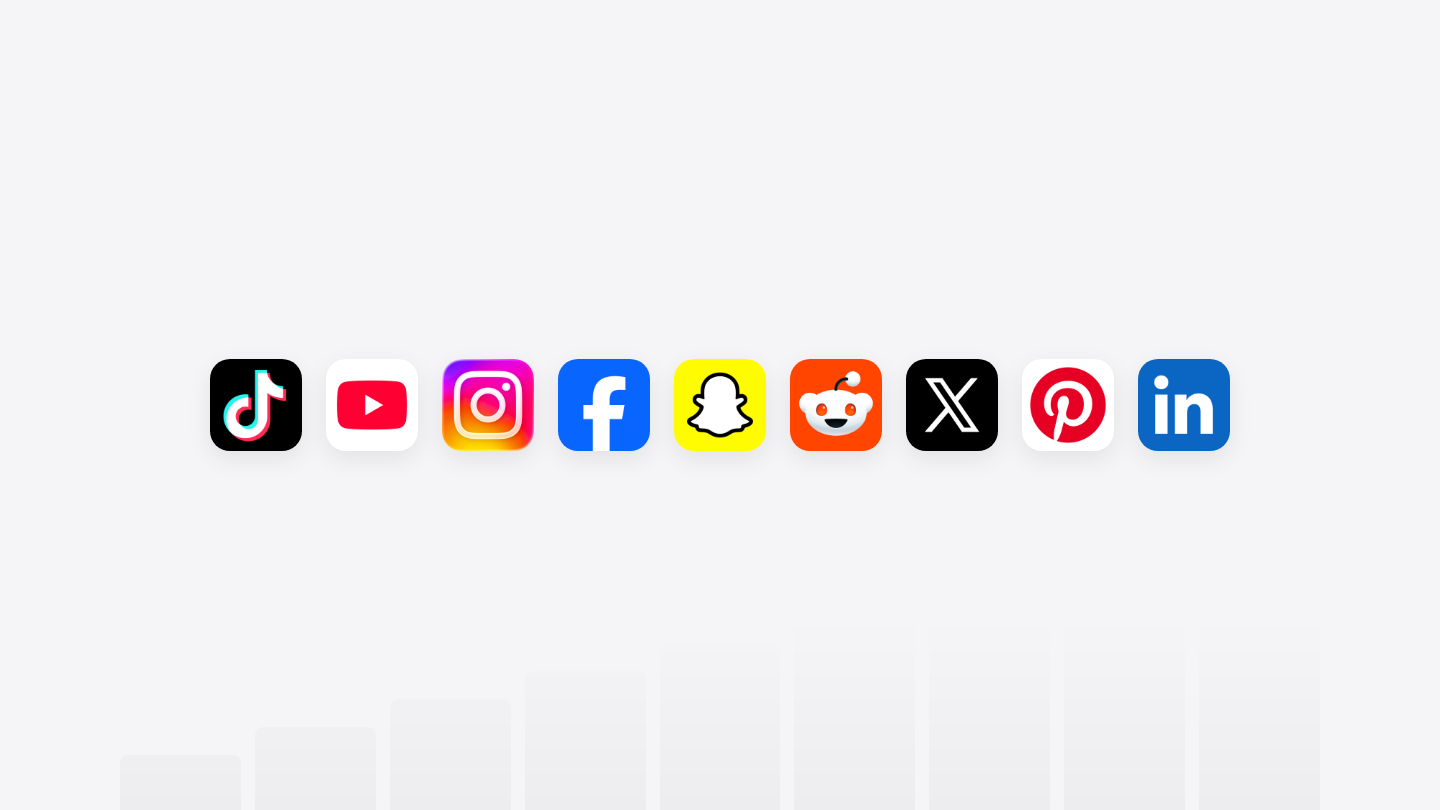
This page compiles comprehensive screen time data for 2026, drawing from DataReportal's Digital 2026 Global Overview, Common Sense Media research, Pew surveys, and our own analysis of 9 major social platforms: TikTok, YouTube, Instagram, Facebook, Snapchat, Reddit, Twitter/X, Pinterest, and LinkedIn. You'll find exactly how much time people spend on screens, where those hours go platform-by-platform, how usage varies by age and country, what the health effects are, and why quality of screen time matters more than quantity.
| Key Screen Time Statistics (2026) |
|---|
| 6 hours 45 minutes per day - Global average screen time, up 2.2% year-over-year (DataReportal, 2025) |
| 7 hours 2 minutes per day - US average screen time, though declining 23 minutes year-over-year (Comparitech, 2025) |
| 9 hours per day - Gen Z average, 2.6x higher than Baby Boomers at 3h 31m (DemandSage, 2025) |
| 2 hours 31 minutes per day - Global average social media time across 6.7 platforms (DataReportal, 2025) |
| 5 hours 19 minutes - Total daily social media time if using all 9 major platforms at average rates |
| 42% of waking hours - Percentage of non-sleep time spent on screens (assuming 8 hours sleep) |
| 129 minutes per day - Average screen time for 2-year-olds, double the WHO recommended maximum (UCL, 2024) |
| 69% of young adults - Percentage who want to reduce their screen time, yet usage keeps rising (Pew Research, 2024) |
These numbers represent a fundamental shift in how humans spend their lives. But the crisis isn't just quantity. It's quality. Fourteen minutes on Pinterest improves mental health (UC Berkeley, 2023). Seven minutes on LinkedIn triggers career anxiety (Zheng et al., 2020). What you do on screens matters more than how long you're on them. We call this The Screen Time Quality Index, and it's the framework that makes sense of everything below.
Table of Contents
- Average Screen Time in 2026
- Screen Time by Platform
- The Screen Time Quality Index
- Screen Time by Age and Generation
- Screen Time by Country
- Screen Time, Mental Health, and the Policy Response
- How to Reduce Screen Time
- Methodology and Sources
- FAQ
Average Screen Time in 2026
Screen time has climbed relentlessly for over a decade. The only decline came in 2022 after pandemic lockdowns ended, but growth resumed in 2023 and accelerated in 2024-2025. We're now back at pandemic-era peaks, except this time without stay-at-home orders.
Year-Over-Year Screen Time Trends
| Year | Daily Screen Time | Change | Key Event |
|---|---|---|---|
| Q3 2013 | 6h 9m | Baseline | - |
| Q3 2017 | 6h 46m | +37 min over 4 years | Smartphone maturity |
| Q3 2019 | 6h 38m | -8 min | Pre-COVID baseline |
| Q3 2020 | 6h 54m | +16 min | COVID spike |
| Q3 2021 | 6h 58m | +4 min | Pandemic peak |
| Q3 2022 | 6h 36m | -22 min | Post-COVID correction |
| Q3 2023 | 6h 40m | +4 min | Growth resumes |
| Q3 2024 | 6h 45m | +5 min | Acceleration |
| Q3 2025 (proj.) | 6h 54m | +9 min | Returning to peak |
Source: DataReportal Digital 2026 Global Overview Report
The 2022 decline was an aberration, not a reversal. Screen time is projected to match 2021 pandemic levels by the end of 2025, but this time without lockdowns forcing people indoors. The increase is voluntary and accelerating.
Screen Time Breakdown by Activity Type
| Activity | Daily Time | Share of Total |
|---|---|---|
| Social media | 2h 31m | 37% |
| Streaming video | 1h 48m | 27% |
| Work/productivity | 1h 12m | 18% |
| Gaming | 56 min | 14% |
| Other (browsing, shopping, messaging) | 18 min | 4% |
Source: DataReportal, 2025
Social media is the single largest category, more than streaming and gaming combined. Unlike work screen time, social media is almost entirely discretionary. The average person could reclaim 2.5+ hours daily by eliminating social apps alone.
The 29-Year Calculation
At 6 hours 45 minutes per day, 365 days per year, from age 10 to 78, the average person will spend 167,484 hours on screens, or 19.1 years of life. But Gen Z, averaging 9 hours per day, will spend 28.8 years on screens. Nearly three decades of human existence translated into pixels. That's more time than most people spend working (13 years), eating (4 years), or socializing in person (6 years). Screen time has become the dominant human activity after sleep.
Screen Time by Platform
Not all screen time is created equal. The 6 hours 45 minutes average obscures dramatic differences in how people use platforms and which platforms consume the most time. Here's the breakdown based on 2025-2026 data from platform analytics and our analysis of 9 major social platforms.
Platform Comparison: Daily Screen Time, Users, and Quality
| Platform | Avg Daily Time | MAU | DAU/MAU | Primary Demo | Quality Index | Deep Dive |
|---|---|---|---|---|---|---|
| TikTok | 95 min | 1.6B+ | ~63% | Gen Z (60%) | ⚠️ Addictive | TikTok Stats |
| YouTube | 49 min | 2.7B | ~56% | Universal (84% US adults) | ⚠️ Mixed | YouTube Stats |
| 38 min | 2B+ | ~50% | Ages 18-34 (62%) | ⚠️ Harmful | Instagram Stats | |
| Twitter/X | 32 min | ~368M | ~67% | Ages 25-34 (38.5%) | ⚠️ Harmful | Twitter/X Stats |
| 31 min | 3.07B | ~69% | Ages 25-44 | ⚠️ Mixed | Facebook Stats | |
| Snapchat | 30 min | 414M DAU | ~100% | Gen Z (51%) | ⚠️ Mixed | Snapchat Stats |
| 18 min/session | 121.4M DAU | Variable | Ages 18-29 (44%) | ⚠️ Mixed | Reddit Stats | |
| 14 min | 522M | ~29% | Female (70%), Gen Z (42%) | ✅ Positive | Pinterest Stats | |
| 7 min | 310M | ~12% | Professionals 25-44 | ⚠️ Harmful | LinkedIn Stats |
Sources: Financial Times (2023), eMarketer (2025), DataReportal (2025), platform reports. DAU/MAU = Daily Active Users / Monthly Active Users, measuring engagement frequency. Quality Index based on research into algorithmic design, social comparison mechanisms, and usage patterns.
Total if using all 9 platforms at average rates: 314 minutes = 5 hours 14 minutes (social media only). Realistic average across 6.7 platforms: approximately 195 minutes = 3 hours 15 minutes.
Understanding the Stack
The math most people miss: if you used every major social platform at its documented average rate, you'd spend 5 hours 14 minutes per day scrolling before streaming, gaming, or working. The reality is less extreme. The average person uses 6.7 platforms, not all 9 (DataReportal, 2025). That's roughly 3 hours 15 minutes of social media daily. Still, the point stands: platform usage compounds. Each app you add isn't a minor distraction. TikTok alone is 95 minutes. Instagram adds 38. Snapchat adds 30. The apps stack on top of each other, and most users don't realize the total.
The Big Three Time Sinks
TikTok (95 min/day): The algorithmic video feed is optimized for infinite scroll. The "For You" page is the most effective attention-capture mechanism ever designed for consumer use. Users rarely close the app voluntarily. They just lock their phones while videos autoplay. At 95 minutes daily, TikTok alone consumes more time than YouTube, Facebook, and LinkedIn combined. See our full TikTok screen time breakdown for session-level data.
YouTube (49 min/day): Longer sessions, less frequent opens. Autoplay and recommendations create "just one more video" loops that extend sessions beyond user intent. YouTube is now the number one streaming service on TVs, capturing 9.7% of total TV viewing time (Nielsen, 2025). That makes it both a mobile and living room attention sink. Full data in our YouTube screen time analysis.
Instagram (38 min/day): Feed scrolling, Reels, Stories, and DMs create multiple engagement surfaces. Users check Instagram 10-14 times per day in brief bursts that accumulate to 38 minutes. The platform's shift toward Reels (short-form video) has increased session time as Instagram competes directly with TikTok. Our Instagram screen time statistics cover the full picture.
Together, these three platforms consume 182 minutes (3 hours 2 minutes), representing 66% of total social media time across all platforms.
The Algorithm Tax
Platforms with algorithmic feeds consume dramatically more time than chronological or search-based platforms:
- Algorithmic feeds: TikTok (95 min), YouTube (49 min), Instagram (38 min), Facebook (31 min)
- Non-algorithmic or intent-driven: Pinterest (14 min), LinkedIn (7 min)
The algorithm isn't neutral. It's a business model optimizing for time spent. Feeds without algorithms show 30-60 minutes less daily usage on average. This gap is one of the clearest signals that platform design, not user preference, drives screen time.
DAU/MAU: The Habit Formation Signal
| Platform | DAU/MAU Ratio | What It Means |
|---|---|---|
| Snapchat | ~100% | Everyone who uses it monthly uses it daily (highest habit formation) |
| ~69% | Strong daily habit across age groups | |
| Twitter/X | ~67% | Strong daily habit, news-driven |
| TikTok | ~63% | Strong daily habit, algorithm-driven |
| ~50% | Moderate daily habit | |
| ~29% | Intermittent, intent-driven use | |
| ~12% | Sporadic checking (lowest habit formation) |
Sources: Platform reports, DataReportal (2025), Similarweb (2025)
High DAU/MAU equals compulsive checking. Low DAU/MAU equals intentional use. Snapchat's near-100% ratio (essentially all monthly users check daily) shows the strongest habit loop, driven largely by streaks. LinkedIn's 12% shows users don't check daily but engage with purpose when they do. This metric matters because it reveals which platforms have become reflexive behaviors versus deliberate choices.
The Screen Time Quality Index: Why 14 Minutes Can Beat 95
This is what every other screen time statistics page misses: quality matters more than quantity. The raw number of minutes you spend on screens tells you almost nothing about the impact on your wellbeing. What matters is what you're doing, how the platform is designed, and whether you're using it intentionally or compulsively.
Consider three scenarios that illustrate why a simple "reduce screen time" message misses the point entirely:
Scenario 1: Pinterest, 14 Minutes Per Day, Positive Impact
A UC Berkeley study (N=418, 8 countries, 2023) found that daily 10-minute Pinterest sessions improved wellbeing, reduced burnout, and increased sleep duration by 7%. Why? Pinterest uses an intent-driven model. Users search for specific ideas, save what they find, and leave. There are no prominent like counts or follower metrics driving social comparison. Users come with purpose, plan projects, and exit. Fourteen minutes on Pinterest leaves people feeling better than when they started.
Scenario 2: LinkedIn, 7 Minutes Per Day, Negative Impact
LinkedIn has the lowest screen time of any major platform at just 7 minutes per day. But those 7 minutes trigger "career FOMO" and what researchers call "ambition envy." Research shows that social media use combined with social comparison correlates with job burnout (Zheng et al., 2020; Deng et al., 2025). Seven minutes of scrolling through peer promotions, funding announcements, and career milestones can trigger career anxiety that lasts for hours after you close the app.
Scenario 3: TikTok, 95 Minutes Per Day, Addictive Impact
TikTok captures the most daily screen time of any platform. Its algorithmic video feed, infinite scroll, and lack of natural stopping points create sessions where 5 intended minutes become 45. A Weill Cornell Medicine study published in JAMA (2025) found that addictive use patterns, not total screen time, were linked to youth mental health risk, with a risk ratio of 2.14 for suicide-related outcomes. The distinction is critical: it's the compulsive, passive nature of TikTok consumption that causes harm, not simply the number of minutes.
The Framework
The pattern across these scenarios reveals a clear framework. We call it The Screen Time Quality Index. When evaluating your own usage or interpreting screen time statistics, ask four questions:
- Active or passive? Voice chatting with friends vs. watching videos on autoplay
- Intentional or compulsive? Searching for recipes vs. infinite scrolling without purpose
- Algorithm-driven or user-controlled? TikTok's For You page vs. Pinterest's search bar
- Social comparison present? Instagram lifestyle envy vs. Discord community chat
Algorithmic feeds + social comparison + passive consumption = harmful. Intent-driven + search-based + active participation = neutral or beneficial. This framework explains why screen time statistics alone don't tell the full story. The mechanism matters as much as the minutes.
| Quality Signal | Harmful Pattern | Beneficial Pattern |
|---|---|---|
| Content delivery | Algorithmic feed (TikTok, Instagram Reels) | Search/intent-driven (Pinterest, focused browsing) |
| Social dynamics | Comparison metrics (likes, followers, achievements) | Community participation (Discord voice, group projects) |
| User behavior | Passive scrolling, no decisions required | Active creation, commenting, purposeful searching |
| Session boundaries | Infinite scroll, autoplay, no endpoint | Natural stopping points, finite content |
| Post-use feeling | Time blindness, regret, anxiety | Accomplishment, connection, inspiration |
Screen Time by Age and Generation
Screen time isn't evenly distributed. Younger generations spend dramatically more time on screens, and they're far more aware it's a problem.
The Generational Divide
| Generation | Age Range | Avg Daily Screen Time | Primary Platform | "I use screens too much" |
|---|---|---|---|---|
| Gen Z | 13-28 | 9 hours/day | TikTok (95 min) | 76% |
| Millennials | 29-44 | 6h 42m | YouTube / Instagram | 62% |
| Gen X | 45-60 | 4h 10m | 54% | |
| Baby Boomers | 61+ | 3h 31m | Facebook / YouTube | 51% |
Sources: DemandSage (2025), Magnet ABA Therapy (2024), DataReportal (2025)
Gen Z spends 2.6x more time on screens than Boomers but is 1.5x more likely to recognize it as a problem. This awareness gap matters: younger users want solutions but lack effective tools or strategies. Older users have lower usage but also lower concern, suggesting habitual use without reflection.
Gen Z: The 9-Hour Generation
Nine hours per day is 56% of waking time (assuming 8 hours sleep). For perspective, Gen Z spends more time on screens than sleeping (9 hours vs. 7.5 hours average for teens). They spend more time on screens than all other leisure activities combined. At 9 hours per day from age 13 to 78, Gen Z will spend 28.8 years of life on screens (DemandSage, 2025).
Where those 9 hours go: TikTok (95 min), YouTube (54 min for younger users), Instagram and Snapchat (30-40 min each), Discord (29 min for ages 16-25), plus gaming (1-2 hours for males). The remainder goes to messaging, browsing, and streaming.
Children and Toddlers: The Crisis in the Data
The most alarming screen time statistics aren't about adults. They're about the youngest users.
Two-year-olds: 98% view screens daily (UCL, 2024). The average 2-year-old spends 129 minutes per day on screens, more than 2 hours, which is double the WHO's recommended maximum of 60 minutes for ages 2-4. High screen time at age 2 correlates with 2x higher risk of emotional and behavioral difficulties by ages 5-6 (UCL, 2024). Even more concerning, high-screen-time 2-year-olds could say 53% of test words compared to 65% for low-screen-time peers, a 12% vocabulary gap (UCL, 2024).
Teens (ages 13-18): American teenagers average 8 hours 39 minutes of entertainment screen time daily (Common Sense Media, 2021). Forty-one percent spend 8+ hours per day on screens. TikTok dominates teen usage at 1 hour 53 minutes per day, more than any other single app (Dreamgrow, 2025).
Parental response: 60% of US parents limit their children's screen time, and 27% enforce limits daily (Pew Research, 2024). But teen screen time continues rising despite parental concern. We're conducting an uncontrolled experiment on child development. An entire generation is growing up with screen exposure unprecedented in human history. The first cohort of "iPad toddlers" is now entering high school, and early indicators including language delays, attention difficulties, and emotional regulation problems are concerning.
Screen Time by Country
Screen time varies dramatically by country, driven by internet infrastructure, cultural norms, work patterns, and smartphone penetration.
| Rank | Country | Daily Screen Time | YoY Change |
|---|---|---|---|
| 1 | South Africa | 9h 37m | +8 min |
| 2 | Kenya | 9h 5m | +12 min |
| 3 | Brazil | 9h 1m | +6 min |
| 10 | United States | 7h 2m | -23 min |
| 47 | South Korea | 4h 44m | +3 min |
| 49 | Germany | 4h 25m | -5 min |
| 50 | Japan | 4h 9m | -2 min |
| - | Global Average | 6h 45m | +5 min |
Source: Comparitech (2025), DataReportal (2025)
A clear trend split emerges. Developing nations like South Africa, Kenya, Brazil, and the Philippines show the highest screen time and fastest growth as smartphone adoption accelerates and mobile becomes the primary internet access point. Wealthy Western nations including the US, UK, and Germany show declining or flat screen time as digital wellness awareness grows. The US decreased by 23 minutes year-over-year, one of the few countries showing meaningful decline, suggesting that cultural awareness campaigns and digital wellness tools are starting to have an impact in some markets.
Screen Time, Mental Health, and the Policy Response
The question isn't whether screen time affects mental health. It does. The question is: which types cause harm, which provide benefits, and where's the tipping point? And why are legislators now treating this as a public health crisis requiring intervention?
The Weill Cornell Finding
A landmark study published in JAMA by researchers at Weill Cornell Medicine (June 2025) found that addictive screen use patterns, not total screen time, are linked to youth suicide risk. Increasing addictive use of social media had a risk ratio of 2.14 for suicide-related outcomes. This distinction is critical: passive, algorithm-driven scrolling is harmful. Active, intentional use is neutral or beneficial. This finding aligns perfectly with The Screen Time Quality Index framework outlined above.
The Mechanisms of Harm
Algorithmic feeds (TikTok, Instagram Reels, YouTube autoplay): Variable reward schedules hijack attention. No natural stopping points exist. Active decision-making is replaced with passive consumption. The user never has to choose what to watch next, so they never have a natural moment to stop.
Social comparison platforms (Instagram, LinkedIn, Facebook): Curated success feeds create distorted baselines for what a normal life looks like. Constant exposure to peers' achievements fuels lifestyle envy on Instagram and career anxiety on LinkedIn, both correlating with anxiety and depression (Zheng et al., 2020; Deng et al., 2025).
Infinite scroll: Removes natural session boundaries. Time blindness is the result, where "5 minutes" routinely becomes 45. Notification-driven compulsive checking: Snapchat streaks, Instagram DMs, and Discord mentions pull users back constantly. The average user checks their phone 96 times per day (Asurion, 2023), largely notification-driven.
Physical Health Effects
Sleep disruption: Blue light from screens delays melatonin production by 1.5-3 hours. Having a phone in the bedroom correlates with a 45-minute average delay in sleep onset. Gen Z averages 7.5 hours of sleep versus the 8-10 hours recommended for teens.
Children's development: High screen time at age 2 correlates with a 12% lower vocabulary (UCL, 2024), 2x higher risk of emotional difficulties by age 5-6, and 43% higher obesity risk in children with 4+ hours per day of screen time. Digital eye strain affects 65% of adults who use screens regularly.
How Much Screen Time Is Too Much?
No single number applies universally, but patterns emerge from research:
- Under 2 hours/day social media: Baseline mental health
- 2-3 hours/day: Mild correlation with anxiety and depression
- 3-5 hours/day: Moderate correlation
- 5+ hours/day: Strong correlation with depression, anxiety, and loneliness
But context matters enormously. Five hours of Discord voice chat with friends is not the same as 5 hours of TikTok scrolling. The Screen Time Quality Index provides a better framework than arbitrary time limits.
WHO recommendations for children: Ages 2-4 should have a maximum of 1 hour per day. Children under 2 should have zero screen time except video calls. The reality: 2-year-olds average 129 minutes per day (2.2x the maximum), and teens average 8 hours 39 minutes per day with no official limit set for their age group.
The Policy Response: Screen Time as Public Health Crisis
For years, screen time was treated as a personal responsibility issue. In 2025-2026, that changed. Legislators now treat excessive screen time, particularly for children, as a public health crisis requiring government intervention.
Virginia's Under-16 Social Media Limit (January 1, 2026): Children under 16 are limited to 1 hour per day on social media without parental consent. Platforms must implement age verification and usage tracking. Penalties reach up to $50,000 per violation.
New York's Mental Health Warning Labels (December 2025): Algorithmic feeds must display a warning: "Caution: Extended use may negatively impact mental health. Limit use and take regular breaks." This is modeled on the U.S. Surgeon General's call for tobacco-style labels on social media.
Australia's Social Media Ban for Under-16s (2024): A complete ban on social media account creation for children under 16, with age verification required and fines up to AU$50 million for systemic platform failures to comply.
U.S. Surgeon General Dr. Vivek Murthy (June 2024): "The mental health crisis among young people is an emergency, and social media has emerged as an important contributor. It is time to require a surgeon general's warning label on social media platforms."
The shift happened because teen depression and anxiety rates rose sharply from 2010-2020, correlating with smartphone adoption. Leaked internal documents showed platforms knew about mental health harms. And parents reported feeling unable to compete with billion-dollar engagement optimization teams. Over 45 US states now have pending legislation on children and social media (NCSL, 2025).
How to Reduce Screen Time
The desire exists. 69% of Americans ages 18-29 want to reduce their screen time (Pew Research, 2024). Fifty-three percent of all Americans feel the same. The challenge is execution, because you're one person fighting platforms designed by hundreds of engineers to capture and hold your attention.
The Digital Wellness Market
Screen time reduction is now a $12.87 billion market growing at 12-15% annually (Precedence Research, 2025). Projected to reach $45-68 billion by 2034 (Fortune Business Insights, 2025). The economic incentive to help people reclaim their time is approaching parity with the incentive to capture their attention.
Evidence-Based Strategies
1. App limits with passcode enforcement: Set daily limits on high-use apps like TikTok, Instagram, and YouTube. Have someone else set the passcode to prevent bypass. Effectiveness: 30-40% reduction in target app usage.
2. Remove apps from the home screen (friction method): Apps stay installed but are hidden in the App Library. The extra 3-5 seconds of friction breaks automatic opening. Effectiveness: 25-35% reduction in compulsive checking. Tools like Blank Spaces apply this principle to your entire iPhone, replacing the colorful app grid with a minimal interface. Apps remain accessible when needed, but visual triggers disappear.
3. Grayscale mode: Remove color from your display (iOS: Accessibility, Color Filters). Reduces visual appeal and makes apps less enticing. Effectiveness: 10-20% reduction in overall screen time.
4. Scheduled Focus Modes: Block notifications during work, meals, and sleep. Effectiveness: 20-30% reduction in daily phone unlocks, which directly reduces total screen time.
5. Physical separation: Leave your phone in another room during deep work. Use an alarm clock instead of your phone alarm. Effectiveness: 40-50% reduction when consistently applied.
6. Replace screen time with alternatives: "Just stop" fails because it creates a void. Successful reducers replace phone time with specific activities like reading, exercise, or hobbies. People who identify concrete replacement activities are 3x more likely to maintain reduced screen time long-term.
The Intentional Design Approach
Most screen time advice focuses on restriction and willpower. But willpower is a losing strategy against platforms optimized by hundreds of engineers for maximum engagement. The alternative: design your digital environment so the default behavior is what you actually want. Remove visual triggers. Add friction to compulsive apps. Create calm defaults. Make intentional use easier than automatic use. This is the philosophy behind tools like Blank Spaces and it's backed by behavioral science: changing defaults is more effective than changing minds.
What doesn't work: Generic "use less" advice without concrete strategies. Guilt-based messaging. Drastic digital detoxes (relapse rate above 90%). And relying on platform-provided screen time tools, which come with an inherent conflict of interest since the same company profits from your attention.
Methodology and Sources
Primary Sources
- DataReportal - Digital 2026 Global Overview Report
- Common Sense Media - Census: Media Use by Tweens and Teens (2021)
- Pew Research Center - Screen time surveys (2024-2025)
- UCL - Toddler screen time and development study (2024)
- Comparitech - Global screen time by country (2024-2025)
- National Conference of State Legislatures (NCSL) - Social media legislation tracker
- U.S. Surgeon General - Warning label op-ed (June 2024)
Platform-Specific Data
Our spoke articles on TikTok, YouTube, Instagram, Facebook, Snapchat, Reddit, Twitter/X, Pinterest, and LinkedIn compile usage data from company reports, third-party analytics (data.ai, Similarweb, Backlinko), and user surveys.
Academic Research
- UC Berkeley / Greater Good Science Center - Pinterest well-being study (2023, N=418, 8 countries)
- Weill Cornell Medicine - Addictive screen use and youth mental health (JAMA, 2025)
- Zheng et al. - Social media use and job burnout (Frontiers in Public Health, 2020)
- Deng et al. - Social media-induced FOMO (Internet Research, 2025)
Limitations
Platform-reported data may underreport usage. Self-reported survey data is subject to recall bias. Correlation vs. causation is difficult to establish in mental health research. Screen time methodology changed in 2023 (DataReportal), limiting year-over-year precision for earlier data points.
Updates: This page receives quarterly updates as new data becomes available. Last updated: February 2026.
Frequently Asked Questions
How much screen time is too much?
There's no universal threshold, but patterns emerge from research. Under 2 hours per day of social media correlates with baseline mental health. Two to three hours shows mild correlation with anxiety. Three to five hours shows moderate correlation. Five or more hours shows strong correlation with depression and loneliness. But quality matters as much as quantity: 14 minutes of intentional Pinterest use produces better outcomes than 7 minutes of LinkedIn comparison or 95 minutes of TikTok scrolling (UC Berkeley, 2023; Weill Cornell, 2025). The Screen Time Quality Index, which evaluates algorithmic feeds, social comparison, and passive consumption patterns, is a better framework than arbitrary time limits.
What is the average screen time in 2026?
The global average is 6 hours 45 minutes per day, up 2.2% year-over-year (DataReportal, 2025). The US average is 7 hours 2 minutes daily, though it declined 23 minutes from the prior year (Comparitech, 2025). Gen Z averages 9 hours per day while Baby Boomers average 3 hours 31 minutes (DemandSage, 2025). Social media alone accounts for 2 hours 31 minutes globally. At 6h 45m daily from age 10 to 78, the average person will spend 19.1 years of life on screens. Gen Z will spend 28.8 years.
How much screen time does Gen Z use?
Gen Z (ages 13-28) averages 9 hours per day on screens, 2.6x more than Baby Boomers and significantly higher than Millennials (6h 42m) or Gen X (4h 10m) (DemandSage, 2025). Seventy-six percent of Gen Z say they use screens "too much," the highest awareness of any generation, yet usage continues rising. Primary platforms: TikTok (95 min), YouTube (54 min for younger users), Instagram and Snapchat (30-40 min each), and Discord (29 min for ages 16-25).
Is social media addictive?
Research shows addictive use patterns, not total screen time, correlate with mental health harm. A 2025 JAMA study by Weill Cornell Medicine found that increasing addictive use of social media had a risk ratio of 2.14 for suicide-related outcomes in youth. Platforms with algorithmic feeds (TikTok, Instagram, YouTube) show higher addictive potential than non-algorithmic platforms (Pinterest, LinkedIn). Key addiction mechanisms include infinite scroll, variable reward schedules, notification-driven checking, and social comparison loops. The average user checks their phone 96 times daily (Asurion, 2023).
How can I reduce my screen time?
Evidence-based strategies include: (1) App limits with passcode enforcement by someone else, yielding 30-40% reduction. (2) Removing apps from the home screen to add friction, yielding 25-35% reduction. (3) Scheduled Focus Modes blocking notifications during work and sleep, yielding 20-30% fewer unlocks. (4) Physical phone separation during deep work, yielding 40-50% reduction. (5) Replacing screen time with specific alternative activities, which produces 3x higher success at maintaining reductions. The key insight: design your environment so intentional use is easier than automatic use. Willpower alone fails against platforms optimized for attention capture.
What are the health effects of excessive screen time?
Mental health: Correlation with depression, anxiety, and loneliness above 3-5 hours per day of social media (Weill Cornell, 2025). Physical health: Sleep disruption from blue light delaying melatonin by 1.5-3 hours. Obesity risk 43% higher in children with 4+ hours per day (UCL, 2024). Digital eye strain affects 65% of adults. Child development: 12% vocabulary gap and 2x emotional difficulty risk in high-screen-time toddlers (UCL, 2024). For 2-year-olds, the 129-minute daily average is double the WHO's 60-minute maximum. Quality matters: algorithmic, comparison-driven, passive use shows stronger negative correlations than active, intentional, community-driven use.
Why is the government getting involved in screen time?
Legislators now treat excessive screen time, particularly for children, as a public health crisis. Virginia limits under-16s to 1 hour per day of social media without parental consent (January 2026). New York requires mental health warning labels on algorithmic feeds (December 2025). Australia banned social media for under-16s entirely (2024). U.S. Surgeon General Dr. Vivek Murthy called for tobacco-style warning labels (June 2024). Over 45 US states have pending legislation (NCSL, 2025). The shift resulted from rising teen depression and anxiety rates (2010-2020) correlating with smartphone adoption, leaked internal documents showing platforms knew of harms, and parental inability to compete with billion-dollar engagement optimization.
Which social media platform has the highest screen time?
TikTok dominates at 95 minutes per day, followed by YouTube (49 min), Instagram (38 min), Twitter/X (32 min), Facebook (31 min), and Snapchat (30 min) (Financial Times, 2023; eMarketer, 2025). TikTok's algorithmic "For You" page is the most effective attention-capture mechanism ever deployed at consumer scale. Its short-form video format and infinite scroll create sessions where users rarely close the app. In contrast, Pinterest (14 min) and LinkedIn (7 min) show dramatically lower usage due to intent-driven rather than algorithm-driven models.